 Cart is empty

Case: Yash Charitable Trust and Ors vs Union of India
Factual Background
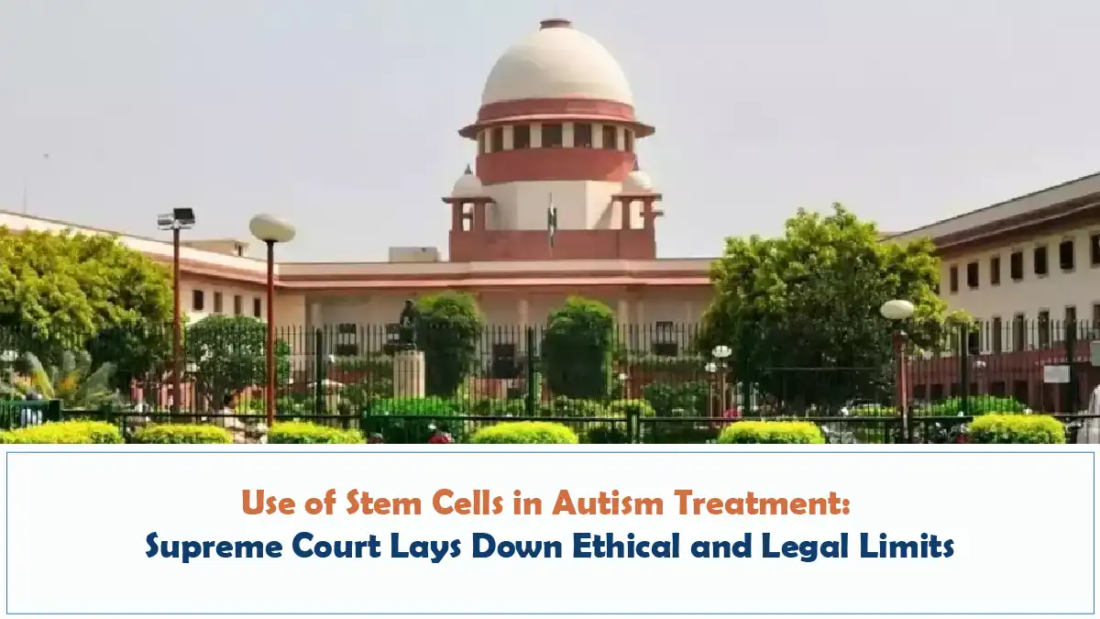
The petitioners approached the Supreme Court raising concerns about the widespread promotion and administration of stem cell therapy as a treatment for Autism Spectrum Disorder (ASD) by various clinics across India. It was contended that such therapies were being marketed as curative or palliative interventions despite the absence of credible scientific evidence supporting their safety or efficacy. The Court noted that individuals with ASD and their caregivers, often unaware of the experimental nature of such interventions, were being induced to undergo expensive procedures outside any approved regulatory or clinical trial framework. The issue before the Court was whether offering stem cell therapy for ASD as a routine clinical service is legally and ethically permissible.
Court’s Analysis
The Court observed that medical practitioners owe a duty to adhere to the reasonable standard of care expected of a competent professional, which requires that any treatment offered must be supported by credible scientific evidence and accepted medical practice. The Court relied on the recommendations of the Ethics and Medical Registration Board (EMRB) of the National Medical Commission, which clearly stated that stem cell therapy is not recommended for ASD and that its use, promotion, or advertisement amounts to professional misconduct.
The Court further noted that national and international guidelines uniformly conclude that there is insufficient scientific evidence to support the use of stem cell therapy for ASD and that offering such therapy creates false hope and exposes vulnerable families to exploitation. It was emphasised that merely obtaining consent from patients or caregivers does not legitimise a treatment that lacks scientific backing, as meaningful consent presupposes adequate and accurate information about efficacy and risks.
The Court clarified that even if stem cells are not treated as “drugs” under the Drugs and Cosmetics Act in certain contexts, this does not make their therapeutic use for ASD permissible as a clinical service. The legality of the intervention must be assessed against the standard of care owed by medical professionals, and offering an unproven and experimental intervention as treatment falls below this standard. The Court concluded that experimental interventions may only be undertaken within the framework of approved and properly monitored clinical trials.
Order of the Court
Taking into account the absence of credible scientific evidence, the ethical guidelines issued by competent regulatory bodies, and the standard of care required of medical practitioners, the Court held that administering stem cell therapy for the treatment of Autism Spectrum Disorder as a clinical service is unethical and amounts to medical malpractice. The Court clarified that stem cell interventions for ASD may be undertaken only within approved and monitored clinical trials conducted in accordance with the applicable regulatory framework. Clinics and medical practitioners offering such therapies outside clinical trials were held to be in breach of professional and ethical standards. The writ petition was accordingly allowed, and appropriate regulatory compliance was directed to be ensured.
Written by Adv. Aiswarya Krishnan