Most of us were never taught how to recognize when a child is struggling on the inside while looking completely fine on the outside. We’re taught to watch for red flags, but by the time the obvious ones appear, the child has often been carrying it alone for a long time. This session closes that gap.
Session Structure:
The session will move beyond awareness into practical, usable skills, including:
- Mapping the context
- Recognizing warning signs
- Opening the conversation safely
- Active, non-judgmental listening
- Navigating Pressure Points
- Knowing when and how to seek help
- A simple takeaway framework
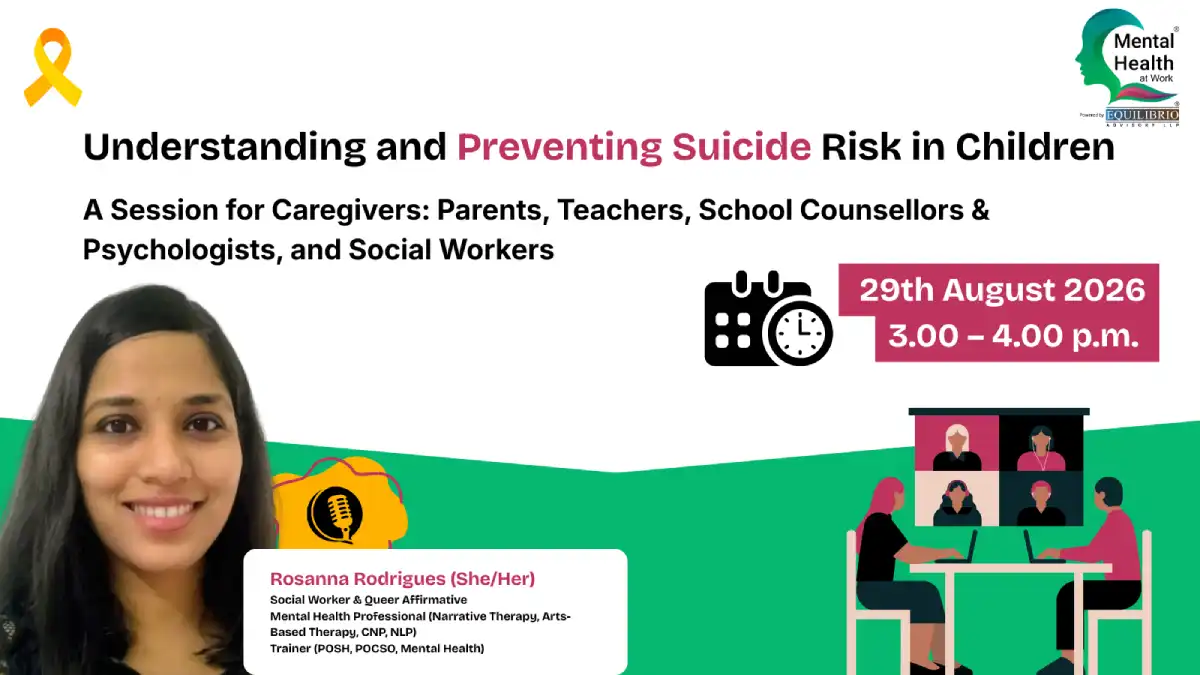
Date: 29th August 2026
Time: 3.00 – 4.00 p.m.
Facilitator: Rosanna Rodrigues (She/Her) – Social Worker & Queer Affirmative Mental Health Professional (Narrative Therapy, Arts-Based Therapy), Trainer (POSH, POCSO, Mental Health) Cisgender Ally
Pricing: 499 Flat
More Details About Workshop:
Why This, Why Now:
September is Suicide Prevention Month, with World Suicide Prevention Day observed globally on September 10. This year’s global theme is “Changing the Narrative on Suicide,” a call to move away from silence and crisis only conversations, toward genuine understanding, before a crisis point is ever reached. This session is built directly around that shift.
What Makes This Session Different:
This isn’t a lecture built on statistics or headlines. It’s a conversation grounded in years of direct clinical and field work with children and young people at risk, including youth in conflict with the law and individuals navigating institutional care. The context is the very real rise in student’s death by suicide and the need for us as parents, teachers, caregivers and interventionists to rise to plug in the gaps and ensure uniforms support.
At its core, the session teaches two things most caregiver training skips entirely: emotional regulation and vulnerability, how they build in a child, how they show up differently depending on who’s watching, and what the adults around a child can do long before things reach a breaking point.
Who This Is For:
Parents, teachers, school counsellors and psychologists, and social workers each see a different slice of a child’s life, and often, none of them see the whole picture alone. This session brings these roles into the same room, with the same language, so the gaps between home, school, and formal care systems start to close.
What You’ll Walk Away With:
- A working understanding of emotional regulation and how to recognize it breaking down in a child, even when they seem fine.
- The ability to spot vulnerability, not just warning signs, including how it hides behind perfectionism, withdrawal, or even high achievement.
- A simple, practical script for opening a conversation about suicidal thoughts safely and without fear of “making it worse.”
- Practical strategies to build the safety circle for a child
- A shared, one-page takeaway framework, so everyone in the room leaves with the same language and the same next steps.
The Bottom Line:
You don’t need a psychology degree to make a real difference in a child’s life. You need the right lens, and the confidence to use it. That’s what this hour is built to give you.
Overview:
Session Structure
The session will move beyond awareness into practical, usable skills, including:
- Mapping the context: Understanding the wider pressures shaping a child’s world today, academic expectation, social comparison, digital life, and shifting family dynamics, so that later signs are read in context rather than in isolation
- Recognizing warning signs: Understanding behavioral, emotional, and verbal cues that a child may be struggling, including subtle shifts in mood, withdrawal, sleep or appetite changes, and changes in academic engagement
- Opening the conversation safely: Learning how to ask directly and calmly about suicidal thoughts without fear of “planting the idea,” since research consistently shows the opposite is true
- Active, non-judgmental listening: Unpacking best practices – how to respond when a child does open up, without minimizing, lecturing, or jumping straight to problem solving; while holding space for one’s own emotions that may come up
- Navigating Pressure Points: Understanding how academic expectation, comparison, neglect, bullying, abuse, rejection and conditional approval can compound a child’s sense of hopelessness, and how to recalibrate this as a caregiver
- Knowing when and how to seek help: Understanding when a situation needs professional support, and having a clear, non-intimidating pathway to access it
- A simple takeaway framework, a short, memorable set of steps parents can use in the moment if they’re ever concerned about their child, designed to be usable under stress, along with helplines, references for therapists and resources.