Case Name: State of Maharashtra v. Ramesh Sukrya Mhatre & Ors.
Factual Background
The case arose from an alleged assault and verbal abuse of three doctors, including a lady doctor, while they were performing their duties at the Labour Ward of Shastri Nagar Municipal Hospital, Dombivli. The prosecution alleged that respondent No.1, Ramesh Sukrya Mhatre, an elected Corporator, led respondents Nos.2 to 4 in the incident on 6 July 2026. The dispute reportedly arose regarding the shifting of a pregnant patient in labour. Respondent No.1 was also alleged to have threatened the informant doctor, causing apprehension and contributing to a delay in registration of the FIR.
The accused were arrested between 8 and 10 July 2026 and initially remanded to custody. Despite the stage of investigation and the criminal antecedents attributed to respondent No.1, the Magistrate granted him bail on 14 July 2026, followed by bail to respondents Nos.2 to 4 on 17 July on the ground of parity. A Division Bench of the Bombay High Court subsequently took suo motu cognizance, stayed those orders and directed respondent No.1 to surrender. The High Court later restored bail, subject to stringent conditions, including residence outside Maharashtra, reporting at a police station in Goa, surrender of passports and prohibition on contacting witnesses.
Court’s Analysis
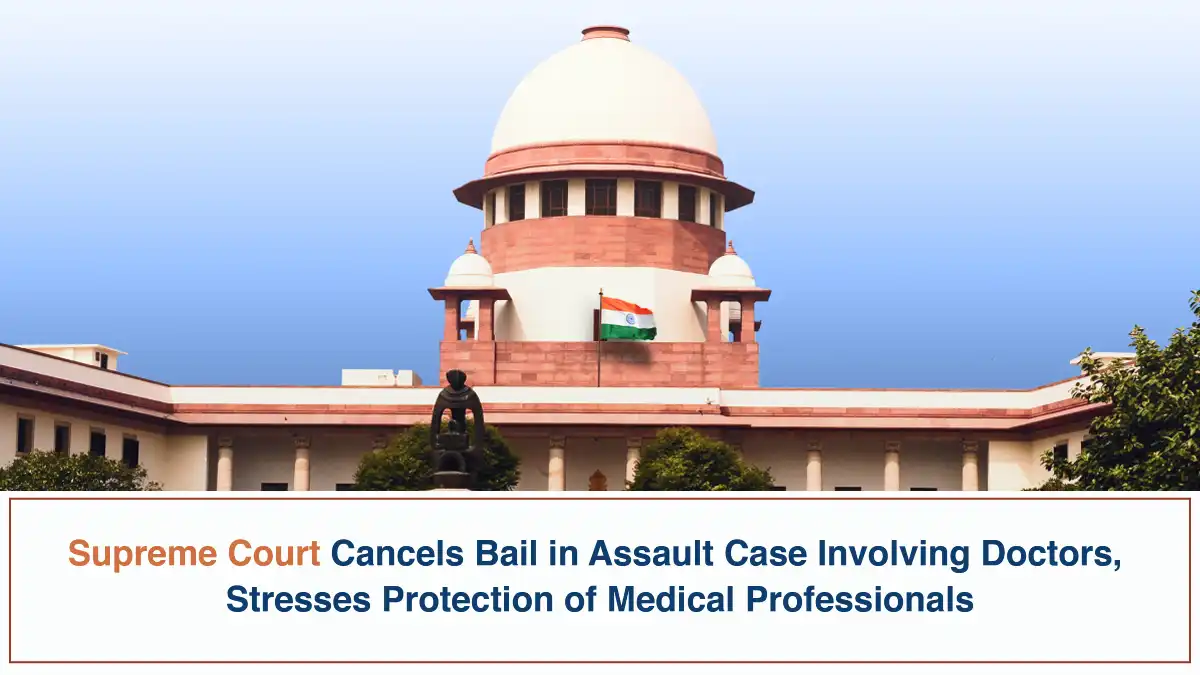
The Supreme Court emphasised that medical professionals require an environment free from physical violence, intimidation and coercion because medical decision-making often occurs under emergency conditions and directly affects human life and health. At the same time, the Court clarified that doctors remain accountable and that patients and families are entitled to challenge negligence, delay or adverse treatment through lawful remedies. What cannot be accepted is substitution of those legal remedies with violence or threats.
The Court attached particular seriousness to the fact that respondent No.1 was an elected representative. It observed that electoral authority cannot become a source of personal or extra-legal power, and an elected representative has a heightened obligation to respect the rule of law
and public institutions. Violence against healthcare workers by persons holding elected office was therefore viewed as particularly grave.
While examining the bail order, the Court found the High Court’s approach internally inconsistent. Having earlier stayed the Magistrate’s bail orders on the basis of serious infirmities and the nature of the allegations, the High Court later restored bail without identifying any cogent intervening circumstance sufficient to displace its earlier prima facie assessment. Mere passage of custody, progress in investigation or anticipated forensic analysis did not adequately explain the departure.
The Supreme Court further held that criminal antecedents are a relevant consideration in bail matters, particularly where they may bear upon the likelihood of repetition, witness intimidation or interference with justice. It noted that respondent No.1 had 18 criminal cases attributed to him, including serious offences, although 16 had ended in acquittal or discharge. The Court also considered the possible statutory consequences under Section 13(1)(a) of the Maharashtra Municipal Corporations Act and the impact of the incident on the medical fraternity, including doctors who resigned or stopped attending duties because of fear.
Order of the Court
The Supreme Court exercised jurisdiction under Article 136 and set aside the High Court’s order restoring bail. Bail granted to respondents Nos.1 to 4 was cancelled, and they were directed to surrender before the trial Court by 5 October 2026. The Court permitted renewal of the bail application if there was a material change in circumstances.
The Special Fast Track Court was directed to endeavour to conclude the trial within six months from the date of the Supreme Court’s order. The trial Court was also directed to ensure adequate protection of material witnesses under the Maharashtra Witness Protection and Security Act, 2017 and the principles laid down in Mahender Chawla. The State Government was additionally directed to independently examine whether preventive-detention provisions were attracted in the circumstances of the case.
Key Takeaway
The Supreme Court reaffirmed that violence, intimidation or coercion against medical professionals cannot replace lawful grievance-redressal mechanisms. In bail matters, courts
must consider the totality of circumstances, including criminal antecedents, witness intimidation, the influence of the accused, the impact upon public institutions and the broader societal consequences of the alleged conduct. The Court also underscored that holding elected office does not confer immunity from ordinary legal restraints and, in fact, carries an enhanced obligation to uphold the rule of law.
Written by Adv. K. Sri Hamsa