
Power and Privilege Web: The Sticky Business of Power and Privilege
A free power and privilege web from Mental Health at Work
The sticky business of power and privilege
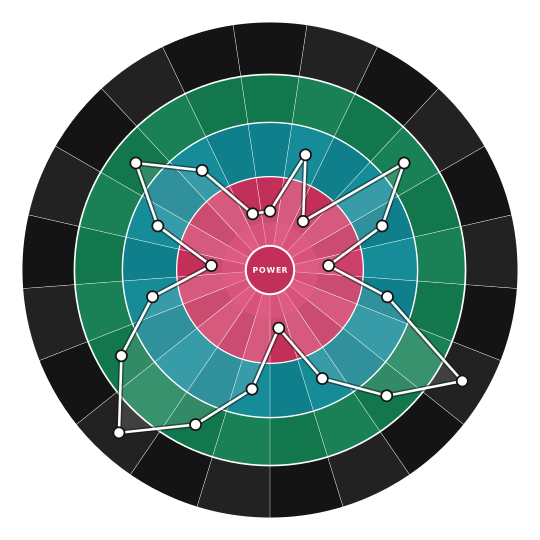
Power works like a web. Near the centre, you feel every thread and can move freely. Out at the edges, the same threads hold you back. Most of us sit close to the centre on some strands and far out on others, and where we sit can shift over a lifetime.
This free power and privilege web lets you plot where you sit across 21 strands of identity and access, from caste and gender to housing and health.
- Private by design. Your choices stay in this browser, and nobody else can see them.
A tool for noticing, not a score
This map grew out of our work with people in organisations and in the therapy room. None of these positions says anything about a person’s worth. They describe how systems tend to treat us.
Plot your web
Notice, without judging
Talk, if you choose
Before you begin
Reflecting on power can bring up old hurt, guilt or anger. All of that is a normal response. Take breaks, go at your own pace, and reach out to someone you trust or a mental health professional if something stays with you.
Your choices stay in this browser only. Nobody else can see them.
Before you plot
Intersectionality at work: where the threads cross
The web shows each strand on its own. Real lives are not lived one strand at a time.
Intersectionality is the understanding that dominant and oppressive systems, practices and structures overlap. Where they meet, they compound the impact felt by people who live with more than one marginalisation, creating a distinct experience that has to be understood on its own terms.
Legal scholar Kimberlé Crenshaw coined the term in 1989. The idea itself grew from a longer tradition of Black feminist thought, including the Combahee River Collective’s writing on “interlocking oppressions” in the 1970s.
More than identity
Intersectionality is not a list of identities to tick off. It is about how systems treat those identities together. A Dalit woman does not face caste barriers and gender barriers one after the other. She faces a combination that neither alone would explain.
A lens for those with privilege
Above all, this is a way for those closer to the centre to see how power and privilege can collide and overlap. These overlaps create barriers for people around us that are often invisible to those of us who never have to meet them.
Context and time matter
Where we sit is shaped by context, norms and the social settings we move through. The same person may be close to power in one room and far from it in another. Over time, some strands move closer to the centre and others drift further away.
As you plot, ask yourself
Where might two or more of your strands pull together? Whose crossings might you not be able to see from where you stand?
Plot your place on the power and privilege web
Choose the level in each segment of the power and privilege web that feels most true for you, in at least four segments. Choose it again to clear it. Your web and your list always stay in step.
A snapshot, not the whole picture
Twenty-one segments and four levels, and there could be many more. This web is a snapshot in time, drawn from common patterns of power we see in workplaces and in our practice. It cannot hold every strand of a life. If something that shapes your experience is missing, notice that too.
How would you like to plot?
Tap cells on the spider web itself.
Larger text, easier on phones and screen readers.
Your web
Look at the shape your thread makes. Where does it reach in towards the centre, and where does it stretch out to the edge? Which of these could you use to make room for someone else?
Plot from a list
Every segment and level in readable text, colour-coded to match the web. Choices here and on the web stay in step.
Age and generation
Age moves power in both directions. Being early in your career can mean less voice; being older can mean being overlooked. Generation adds the era we came of age in. Most workplaces today hold five generations at once.
Silent Generation
Born1928–1945
Age in 202681–98
Rarely at work now, yet often the elders whose care shapes colleagues’ days.
Baby Boomers
Born1946–1964
Age in 202662–80
Often senior and well networked. Can face pressure to retire and be skipped for learning.
Gen X
Born1965–1980
Age in 202646–61
Often in leadership. Many care for children and ageing parents at once.
Millennials
Born1981–1996
Age in 202630–45
Much of middle management. Juggling care, housing costs and burnout risk.
Gen Z
Born1997–2012
Age in 202614–29
Early career with less positional power. Often vocal on wellbeing, sometimes dismissed for it.
Gen Alpha
Born2010–2024
Age in 20262–16
Children of today’s workforce. Their needs shape their parents’ working lives.
Gen Beta
Born2025–2039
Age in 20260–1
The newest babies, and the reason many of your people are new parents.
Use labels with care
Generational boundaries are not a hard science and vary by source. Labels can slide into stereotypes and often reflect more privileged lives.
Read it in context
These names come from US research. In India, coming of age before or after 1991, or before or after cheap mobile data, may matter more. Ask people what shaped them.
A question to sit with
Whose ideas get airtime in your meetings? Notice when someone is dismissed as too young to know, or too old to change.
For facilitators and leaders
Using the power and privilege web with a group
Running a workshop? Pair this power and privilege activity with our workplace mental health training, or talk to us about a facilitated session for your team.
Keep it personal and private
Invite people to plot themselves quietly first. Never ask anyone to place a colleague, and never collect or display individual webs.
Make sharing a choice
Offer pairs or small groups, with a clear right to pass. Disclosure of caste, sexuality, health or migration can carry real risk at work.
Hold the feelings in the room
Guilt, shame and anger can all surface. Name them as expected, slow down, and point people to support, including your EAP or a counsellor.
Move from noticing to action
Close by asking where each person holds power, and one small way they could use it to make room for someone else.
Power and privilege web: your questions answered
Short answers about how the web works, who it is for and how your data is handled.
What is a power and privilege web?
A power and privilege web is a reflection tool that maps how parts of identity and circumstance, such as gender, caste, wealth or health, place us closer to or further from power. Ours is drawn as a web with 21 segments and four levels, so you can see your own pattern at a glance.
How do I use this power and privilege web?
Choose at least four segments and mark the level that feels most true for you right now, either by tapping cells on the web or by using the list. Your thread joins your choices into a shape. Then notice, without judging, where you move freely and where you feel the pull.
Is my data saved or shared?
No. Your choices stay in your own browser and nobody else can see them. Clearing your web removes them. Sharing what you notice with others is always your choice.
Can I use the power and privilege web in a team workshop?
Yes. It works well as a privilege web for workplace sessions, as long as people plot themselves quietly first and nobody is asked to place a colleague. The facilitator tips above explain how to keep it safe, and we run facilitated sessions on power, privilege and belonging for teams and leaders.
What does intersectionality at work mean?
It means recognising that systems of power overlap, so a person facing more than one barrier, for example caste and gender together, has an experience that neither explains alone. Our workplace wellbeing programmes are shaped by intersectional, trauma-informed practice.
Who created this power and privilege web?
Mental Health at Work, part of Equilibrio Advisory LLP, created it from work with people in organisations and in therapy. It is inspired by power and privilege webs used in anti-oppression practice. You can meet our team, or share the tool with credit to us.
We offer inclusive mental health support.
If this power and privilege web stirred something up, you do not have to sit with it alone. Mental Health at Work offers therapy, support groups and workplace programmes shaped by intersectional, trauma-informed practice.
Website
Bringing this into your organisation? We run facilitated sessions on power, privilege and belonging for teams and leaders.
© 2026 Mental Health at Work, Equilibrio Advisory LLP. Shaped by our work with people in organisations and in therapy, and inspired by power and privilege webs in anti-oppression practice, including the work of the Canadian Council for Refugees.
You are free to share this tool with credit to Mental Health at Work, Equilibrio Advisory LLP. Please do not adapt it or sell it.