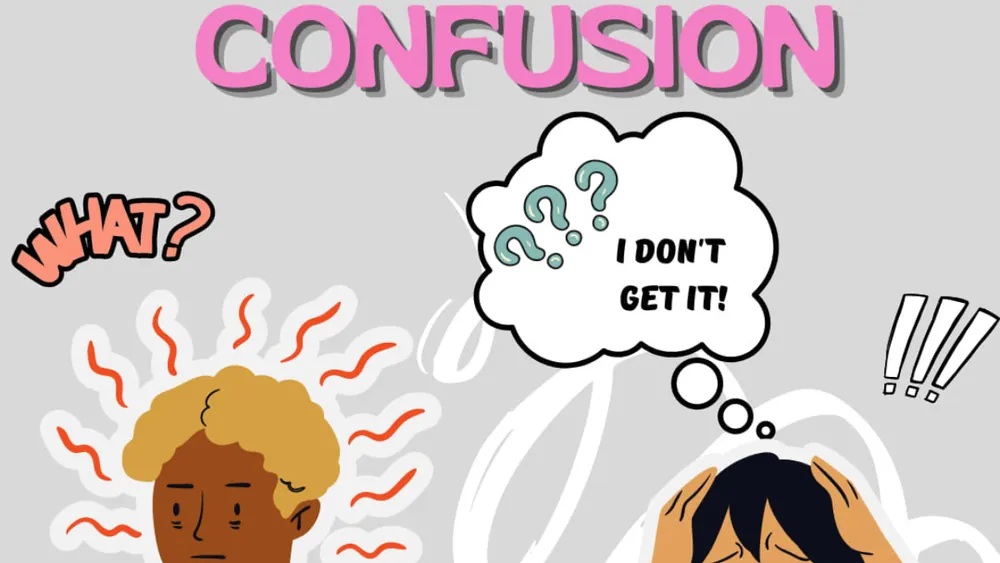
Confusion arises when information does not make sense or conflicts with what we already know. It can be stressful, but it is also a sign that we are processing something new.
About confusion
Confusion is that emotion that arises when a person perceives the information they have received does not make sense to them, usually when this information does not fit in with the information they already have or believe to be true. People often feel that they can’t think clearly and are disoriented, thereby leading to an inability or reluctance to make decisions when they experience confusion. This may arise because in this state of confusion a person may not know what to do.
When people are confused, one of three things is likely to happen – either they hold onto their existing ideas and reject the new knowledge; or they assimilate the new information and replace the old one, or they figure out a way to maintain both beliefs without any conflicts.
Confusion may also come up when a person is exhausted, unwell and fatigued, rendering them unable to process information.
Confusion may be accompanied by associated emotions and experiences like irritation, moodiness, brain fog, difficulty holding attention or focus and drowsiness. In more severe instances, confusion can lead to muttering, illogical speech, losing track of where you are, forgetting, and the ability to perceive things that aren’t there. This can occur especially if a person is exhausted or has other medical conditions.
Experiencing confusion can often be scary, and people might feel like they are lost. These are a few strategies that can help you cope with confusion.
Ask for help: You don’t have to deal with this emotion alone. When trying to sort through confusion, having someone present to listen, validate our feelings, and give us advice when we ask may be quite beneficial.
Cost-benefit analysis: write down the pros and cons of things you are conflicted about and subsequently make an informed decision, aligned with your values and hoped
Practice grounding exercise:Take full advantage of your five senses and count the number of items you can see, touch, hear, smell, and taste while being attentive to each one. Feel the ground under your feet, pay attention to the sky, take deep breaths.
Journal your thoughts:Just let it all flow on paper. It doesn’t have to immediately make sense.
Practicing compassionate personal self-talk: Substitute any critical negative self-talk with compassion for yourself.
Remember, it is okay to feel what you are feeling. You are not alone!
It is okay to reach out for help if you are unable to cope with confusion. Asking for help does not make you weak, and we encourage you to proactively seek therapeutic support if you feel you need to!
How do you respond to feeling of confusion?
How confusion can show up at work
At work, confusion may follow unclear instructions, changing priorities or too much information at once. It can cause hesitation and mistakes.
Healthy ways to respond
- Write down what you know and what you do not.
- Ask clarifying questions as early as possible.
- Break the problem into smaller parts.
- Give yourself time, since clarity often comes after rest.
Questions to reflect on
- What exactly is unclear to me?
- Who could help me clarify it?
Frequently asked questions
Is confusion a bad sign?
No. It often means you are learning or facing something new.
How can managers reduce confusion?
By giving clear priorities, written instructions and opportunities to ask questions.
This post is for general awareness and does not replace advice from a qualified professional.