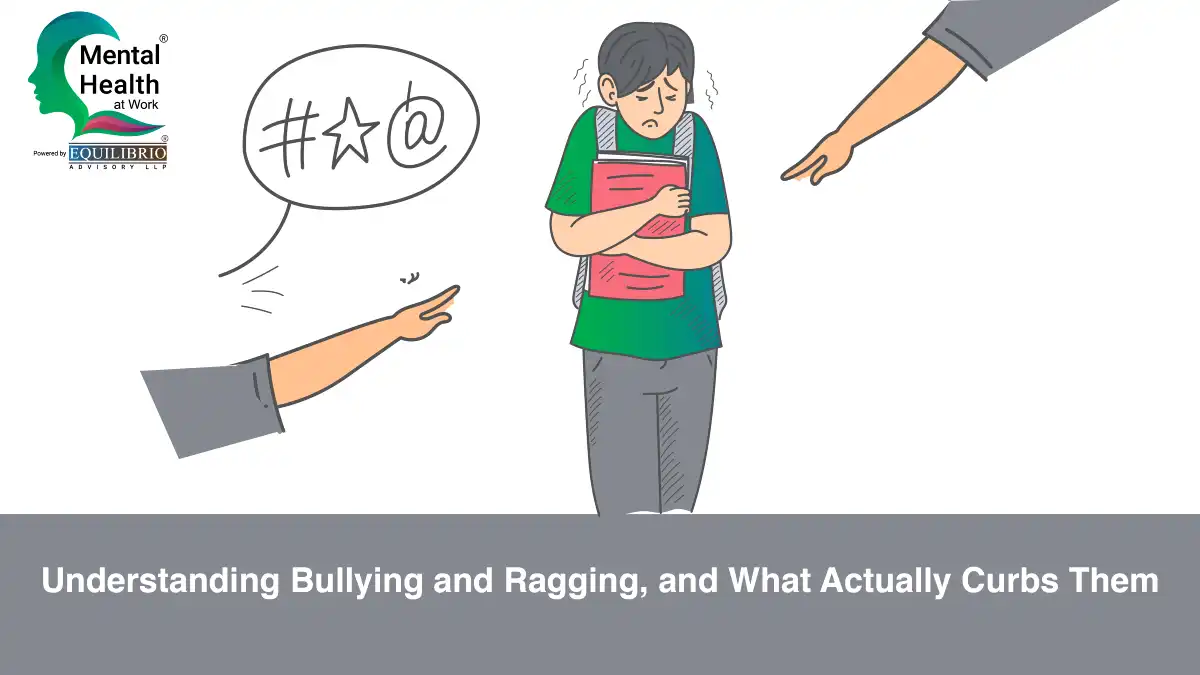
Most institutions respond to bullying and ragging the same way: write a policy, set a punishment scale, and hope the threat of consequences does the rest. It rarely does, on its own.
Decades of research on school and campus violence point to something less comfortable but more useful: these behaviours are not random cruelty from a few “bad” students. They are predictable outputs of specific group dynamics, power structures, and unmet developmental needs. If an institution wants to actually reduce bullying and ragging, it needs to understand why these behaviours happen in the first place. That understanding is what this article is for.
What Bullying is, and how Ragging fits inside it
Psychologists generally define bullying by three features, established most influentially by Dan Olweus, the Norwegian researcher whose work founded the modern field of bullying prevention:
1) Intent to harm. The behaviour is not accidental or a misunderstanding.
2) Repetition over time. A single unpleasant interaction is a conflict, not bullying. Bullying is a pattern.
3) A power imbalance. The person doing the bullying has more social status, physical size, seniority, numbers, or some other form of leverage that the target cannot easily counter.
Ragging, as practiced in Indian higher education, is essentially bullying with a specific institutional shape. It is organized around seniority & the power imbalance is structural, not just personal. It clusters around the start of an academic year with freshers being especially vulnerable because they lack social capital, allies, or familiarity with the environment. And it often gets defended as tradition, an “initiation,” or a way of building camaraderie. This language that would sound strange applied to workplace bullying, but somehow survives in campus culture. Underneath the different label, the psychological mechanics are the same as any bullying dynamic.
Why It Happens: The Psychology Underneath Ragging
Power and status maintenance. Seniors who rag freshers are often, consciously or not, reasserting a hierarchy that felt threatening to lose. A new batch of students represents a shift in who “belongs” and who doesn’t yet, and ragging is one of the crudest ways a group re-establishes who is in charge of that boundary.
Deindividuation and group dynamics. People do things in a group they would not do alone. When ragging happens in a crowd, in a dark hostel corridor, at night, with everyone egging each other on, individual responsibility diffuses.
Psychologists call this deindividuation: the sense of being an anonymous part of a group weakens a person’s normal restraint and empathy. This is precisely why the UGC Regulations’ emphasis on identifying and punishing all participants, not just the ringleader, matters; diffused responsibility is part of what makes the behaviour possible.
1) Intergenerational transmission (“I went through it, so should you”): A significant driver of ragging’s persistence is that many seniors were themselves ragged as freshers. Rather than this producing empathy, it frequently produces a normalization effect: having survived it, they reframe the experience as valuable, even necessary, and pass it on. Breaking this cycle requires more than banning the act; it requires changing what the institution rewards and models as belonging.
2) Belonging, and the specific vulnerability of freshers: Adolescents and young adults have a strong, developmentally normal need to belong to a group. Ragging exploits this directly: freshers are told, implicitly or explicitly, that enduring humiliation is the price of acceptance. This is also why ragging can look, from the outside, like it has willing participants. It rarely does; it has frightened participants who have been told that compliance is the only path to social safety.
3) The bystander effect: Most bullying and ragging happens with witnesses. Research consistently finds that up to 80% of students report having witnessed bullying, but only 20 to 30% intervene, and for cyberbullying the intervention rate can drop as low as 10%. This is not primarily a failure of character. It reflects diffusion of responsibility (assuming someone else will act), fear of becoming the next target, and simple uncertainty about what to actually do. This gap, between witnessing and acting, is one of the single most productive places to intervene, and the evidence below shows why.
Unpacking the cost of not investing in Anti-Ragging /Anti-Bullying Initiatives:
The scale of the problem, globally, is larger than most people register. UNESCO’s most recent global data finds that roughly one in three students has experienced bullying in the past month, with physical bullying most common in most regions and psychological bullying more prevalent in North America and Europe. Students perceived as different in any way, physical appearance, race, nationality, or economic background, are disproportionately targeted, which is precisely why India’s 2016 legal expansion of “ragging” to explicitly include identity-based discrimination reflects real evidence, not just cautious drafting.
Indian data on ragging isn’t documented in depth when compared with the amount of incidents that take place. Society Against Violence in Education (SAVE) did an analysis of complaints registered on the National Anti-Ragging Helpline and reported that:
- 3156 complaints were registered from 1946 institutions across 2022 to 2024 and
- 51 students had died in incidents related to ragging in this period
- Medical college students accounted for around 1.1.% of students but numbers wise they had 38.6 % of the total complaints, 35.4 % of serious complaints, and 45.1 % of ragging-related deaths during 2022-24.
It is important to note that this data is only a reflection of the complaints that got registered and thus the real numbers remain unknown, as people may tend to push it aside due to shame and fear & even reputational risk.
The impact of ragging however is something that cannot be ignored. In fact the impact is not only to the individual experiencing the ragging but may have further implications. Below is a break down:
a) For the person targeted: Impact to wellbeing with anxiety, depression, disrupted sleep, academic decline, social withdrawal, and in the most severe cases, self-harm or suicide. These are the consistent findings across decades of bullying-victimization research, and they are precisely why Aman Kachroo’s death in 2009 is remembered as the case that moved India’s regulatory framework into existence.
b) For the person doing the bullying: This is the part institutions tend to overlook. Longitudinal research links habitual bullying perpetration in adolescence to a meaningfully elevated risk of later antisocial and even criminal behaviour in adulthood. Punishing the act without addressing what’s driving it, insecurity, a need for status, modeling from older students, or from home, leaves that underlying trajectory largely untouched.
c) For bystanders: Students who witness bullying repeatedly and don’t intervene show their own elevated rates of anxiety, depression, and (in some studies) suicidal ideation, even though they were never directly targeted. Watching cruelty and feeling unable to stop it is its own psychological burden.
d) For the institution: A campus or hostel where ragging is tolerated develops what researchers call a poor “school climate.” This shows up as lower trust in authority, worse academic outcomes across the board (not just for targeted students), higher dropout, and, eventually, reputational and legal exposure. Failure to comply with the measures laid down under the guidelines may also attract adverse action.
What evidence say actually works:
Here is what controlled research says reduces bullying and ragging.
1. The whole-institution approach, not isolated rules
The most rigorously studied bullying prevention program in the world, the Olweus Bullying Prevention Program (OBPP), is built on one core premise: bullying is a systemic problem reflecting the culture of an institution, not simply the character of a few bad actors. It works simultaneously at the:
– Institution level (policy, climate, leadership),
– Classroom or hostel-block level (supervision, discussion, clear norms),
– Individual level (direct intervention with those bullying and those targeted), and the
– Community level (parents, wider stakeholders).
Large-scale evaluations have found reductions in bullying perpetration of roughly 19 to 20% and in victimization of roughly 15 to 16% across well-implemented anti-bullying programs generally, with the original Norwegian OBPP trials showing even larger effects, up to a 64% reduction in being bullied and 53% reduction in bullying others in the initial large-scale study. Long-term follow-up, up to eight years later, found that institutions that sustained the program kept bullying rates roughly 25 to 40% lower than institutions that let it lapse. The clear lesson: this only works as a sustained institutional culture.
2. Training bystanders to act, specifically and concretely
Given how large the “witnessed but didn’t act” gap is, several programs now train bystanders in specific, low-risk intervention strategies rather than just telling them “speak up.” One well-studied model, STAC (Stealing the show, Turning it over to an adult, Accompanying the targeted student, Coaching compassion toward the person doing the bullying), gives students concrete scripts rather than vague encouragement, and has shown measurable reductions in both bullying victimization and perpetration, along with reduced anxiety, depression, and suicidal ideation among the bystanders themselves.
A broader meta-analysis of bystander interventions across bullying and cyberbullying contexts found a positive overall effect and specifically found that programs building empathy and concrete social skills, not just awareness, were the most effective. For a campus, this suggests that “see something, say something” posters accomplish very little on their own; what moves the needle is training seniors, mentors, and even faculty in exactly what to say and do in the moment.
3. Restorative approaches alongside, not instead of, formal punishment
Punitive measures send an important signal, but on its own it does little to repair the underlying dynamic, especially in a residential, ongoing-relationship setting like a hostel, where the same students continue living alongside each other after the punishment concludes. Restorative practices, structured conversations that require the person who caused harm to understand its impact and take responsibility, paired with support for the person harmed, are increasingly used alongside formal discipline because they address what punishment alone cannot: the ongoing relationship and the campus climate around it. This does not mean going easy on serious harm; it means recognizing that suspension and fines control behaviour, while restorative processes are what actually change norms.
4. Structured mentoring, done early and consistently
Positive, structured contact with seniors who are explicitly framed as supporters rather than authority figures gives freshers an alternative source of belonging that doesn’t run through ragging. This is one of the reasons India’s UGC Regulations specifically mandate a Mentoring Cell with senior student volunteers assigned to small groups of freshers. This only works if mentors are genuinely trained and if the relationship starts before the vulnerable period, not after an incident has already occurred.
5. Reporting systems that are actually psychologically safe to use
National Anti-Ragging Helpline:
Research on why students underreport is consistent: they don’t believe adults will handle it effectively, they fear social retaliation, or they don’t trust confidentiality. UNESCO’s cross-country analysis found that institutions with a real reduction in bullying shared a specific combination: a commitment to a positive climate, effective reporting and monitoring systems, evidence-based programming, trained staff, and genuine support and referral pathways for affected students, not just a complaint box. A reporting mechanism that isn’t paired with visible, fast, protective follow-through teaches students not to use it. The reporting mechanism currently does exist, but it is underutilised. The National Anti-Ragging Helpline is working 24/7 and complaints can also be emailed which is now monitored by an external agency (C4Y) as well to ensure streamlining of the process.
6. Leadership modelling and consistent adult response
Students, across multiple studies, report being far more likely to intervene or report when they believe the adults around them will respond competently and consistently. Where staff are seen as low in self-efficacy for handling bullying, or inconsistent in how they respond, reporting rates drop and bullying rates rise. This means training wardens, faculty, and squad members isn’t a formality; it directly shapes whether students trust the system enough to use it.
Conclusion:
Ragging is a complex concern that needs to be understood from the perspective of compliance with law and relevant guidelines, but also from the psychosocial lens of human behaviour. The former sets the floor, what must happen after harm occurs. But the latter helps build safety nets and preventative action that better supports the curation of safe and equitable spaces for all.
*Note: This article is written for general understanding and institutional planning. It is not a substitute for professional mental health assessment or crisis support. If you or someone you know is in distress related to bullying or ragging, India’s National Anti-Ragging Helpline (1800-180-5522, 24×7) is available, and a school or campus counsellor should be involved directly rather than relying on this document alone.
Written by: Mental Health at Work team
Sources
Olweus, D. and colleagues, evaluations of the Olweus Bullying Prevention Program:
ScienceDirect, large-scale U.S. study
Clemson University, long-term Norwegian follow-up
Cost-effectiveness modelling study, ScienceDirect
UNESCO, “Behind the Numbers: Ending School Violence and Bullying” and related releases:
UNESCO, global findings
UN News coverage
Global Education Monitoring Report
STAC bystander intervention research:
JMIR Formative Research
PMC, usability study
ERIC, bystander intervention model study
Meta-analysis of bystander interventions across bullying and cyberbullying:
PubMed
KiVa antibullying program, bystander-focused review:
Frontiers in Psychology
Other data references:
- https://www.firstpost.com/health/india-recorded-51-ragging-related-deaths-in-colleges-from-2022-to-2024-report-13874413.html
- https://www.outlookindia.com/national/ragging-culture-looking-back-at-the-death-of-aman-kachroo-that-pushed-sc-to-enact-measures-news-313399